A Tapestry of Connection

This project has been an absolutely fantastic learning opportunity for me, and as I write this, I realise it’s the final blog post in this series. It has truly opened up so many new avenues.

While not all prints I made achieved the desired outcome, the process itself was a profound learning experience. I pushed the boundaries of my practice, gaining confidence in combining various artistic techniques.

The support from the VACMA Scotland bursary played a crucial role in the successful execution of the A Tapestry of Connection project by providing a material budget that facilitated extensive exploration and experimentation. The learning curve was notably steep, particularly with the precise nature of the photopolymer process, which necessitated numerous tests and adjustments

My fieldwork was a particular highlight, blessed with perfect weather – sunny and warm throughout. This ideal environment allowed me to make excellent connections with the eco-walkers, who generously let me photograph them. I learned so much about the locale, its rich traditions, the unique character of the place, and especially about the diverse plant life thriving on the bog moorland. This firsthand experience was invaluable in informing my artistic practice.

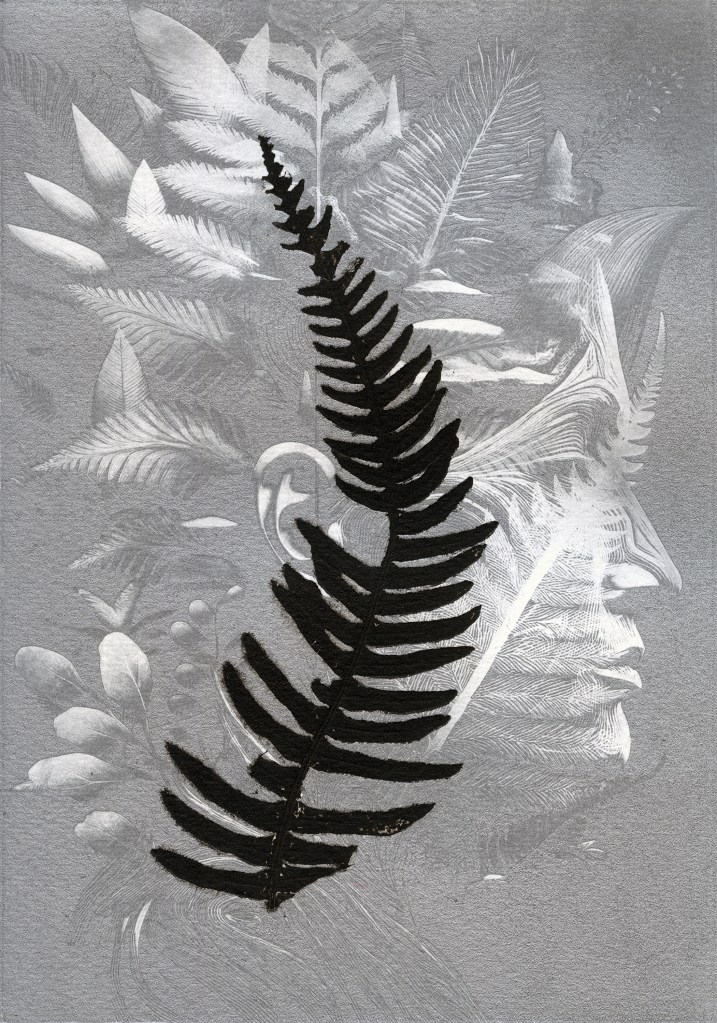
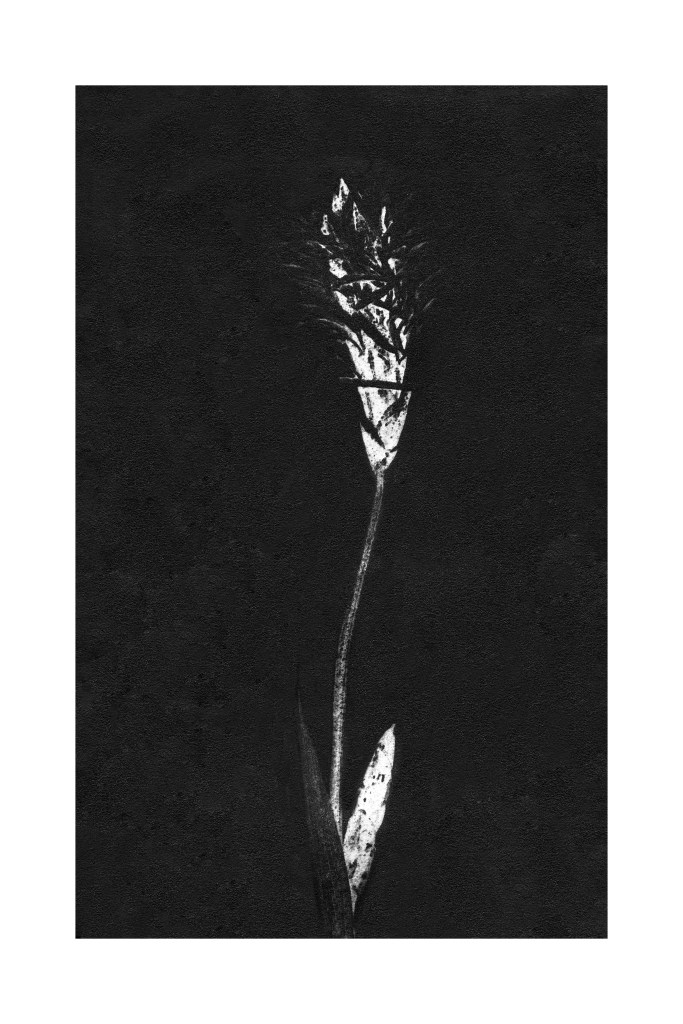
I can confidently say that I managed to achieve everything I set out to do. While there were certainly a lot of technical hurdles to overcome, perseverance paid off. The culmination of all this effort is a single, image, from which I’ve been able to create a small edition. This project truly pushed me to explore a new way of making my prints, challenging my previous methods and fostering a significant artistic evolution.

A Tapestry of Connection

The past couple of weeks have been a whirlwind of activity, culminating in the conclusion of my fieldwork research. Just as I wrapped up this significant chapter, the weather decided to mirror the intensity of my schedule. We’ve transitioned from an extreme dry and hot spring to a dramatic shift marked by torrential rainstorms and fierce winds reaching up to 60 mph.

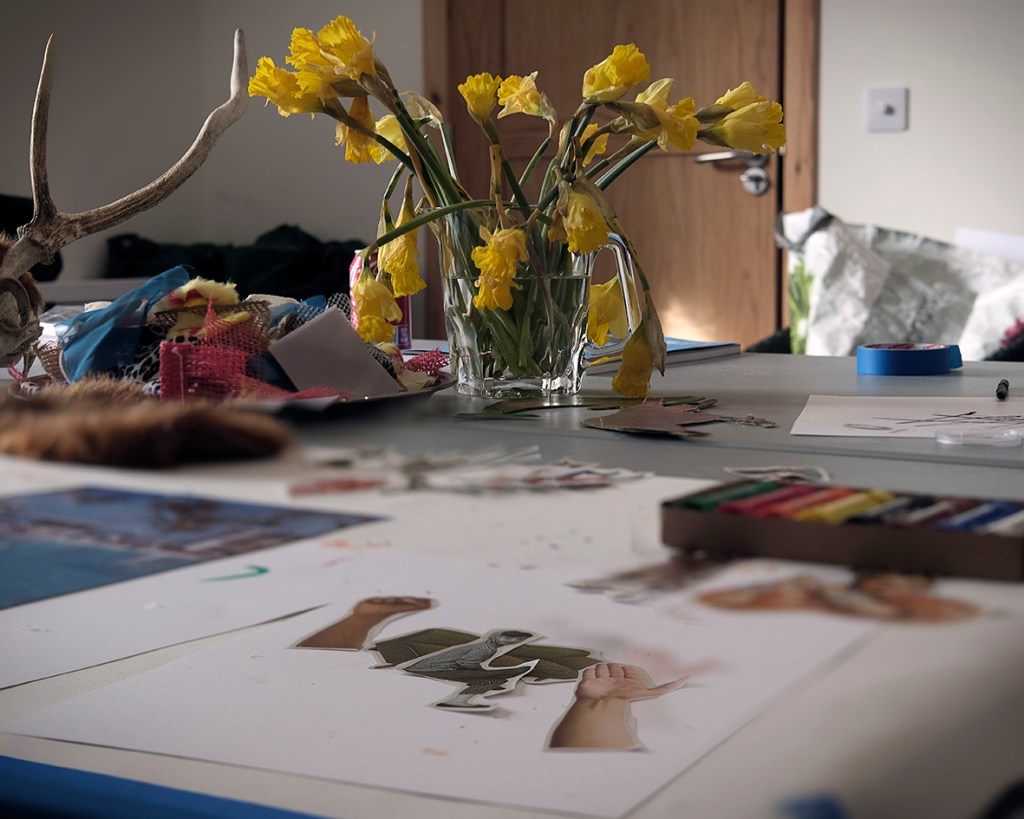
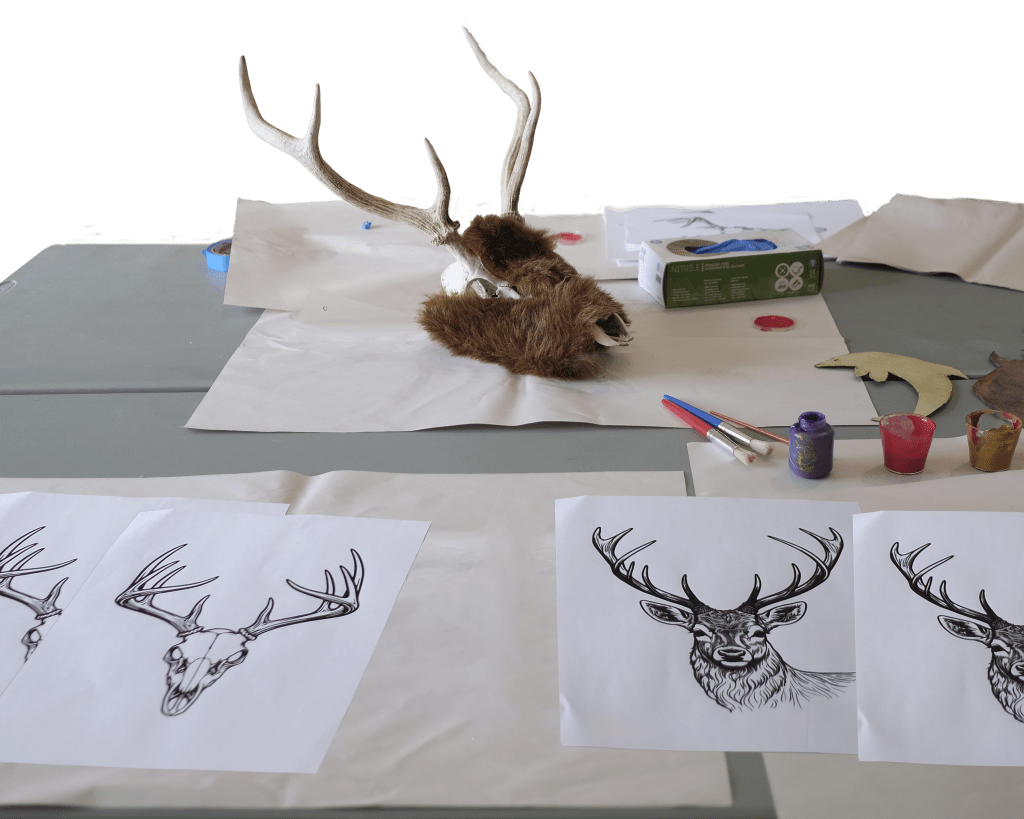
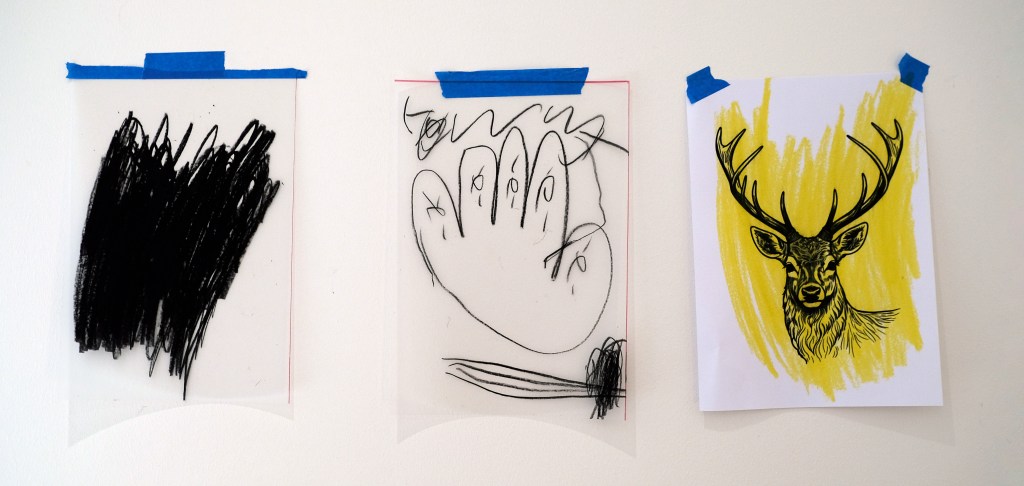
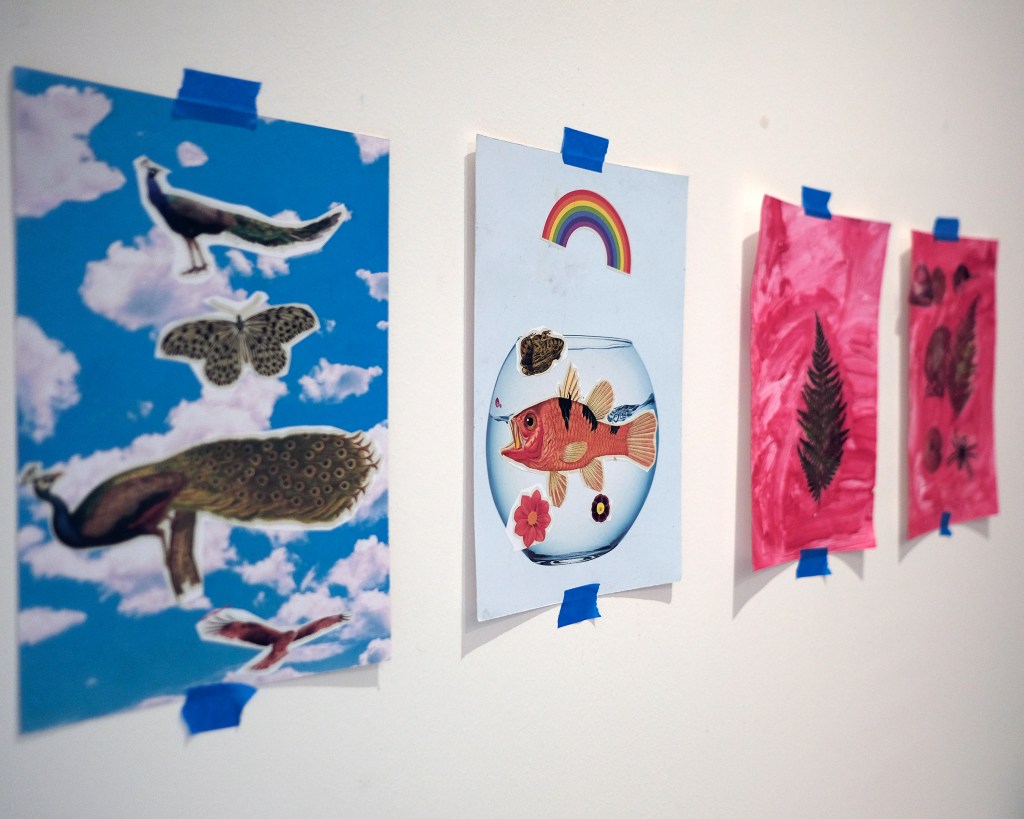
I have now successfully conducted the two workshops for service users from the Day Care centre in Lionacleit, these were held in the lovely workspace at Ceann na h-Àirigh (Grimsay Community Association). These sessions focused on mark-making techniques using stencils and simple printing processes, fostering creativity among participants. We explored various artistic expressions together, and I am eager to continue collaborating with these students in future projects.

I have begun planning and crafting images for my photopolymer gravure prints. These prints will be inspired by and made with the collected materials, photographs and drawings I gathered during my fieldwork research. Today marks an exciting milestone as I prepare to pull some of these prints, transforming ideas into tangible artworks.

A Tapestry of Connection

Day Twenty 23 05 25


View looking out to Lochmaddy – Beinn Lì (Ben Lee) is the hill on the left of this photograph 12.30 PM

12.30 pm, on my last walking day of on-site field work research for my project “A Tapestry of Connection”. I turned up the path towards Blathaisbhal hill and was greeted by a cuckoo perched on a post, its presence as clear as day. I’ve been serenaded by its distinctive call on several walks, but today it decided to make a more personal appearance. This pretty little migratory bird only sings its signature tune when breeding, and I felt privileged to witness it. It’s amazing to think that this bird has flown all the way from East Africa, where it maintains a more subdued tone. The Common Cuckoo are known for their unique breeding habits – they are brood parasites. They lay their eggs in the nests of other birds, which then raise the cuckoo chicks as their own.

references
  • Cuckoo Facts. – The RSPB
  • Common Cuckoo. – BirdLife International
  • Migration Patterns of the Common Cuckoo -National Geographic
  • Brood Parasitism in Birds. – Encyclopedia Britannica
  • Cuckoo Breeding Habits. – BBC Wildlife

I continued my walk, I looked up to see the sea eagle soaring above me once again – I’m thrilled to have had this encounter.

As I reflect on my month-long journey in one of the hottest springs on record, I noticed a significant transformation in this peaty boggy landscape. Initially, the ground was wet and boggy, necessitating the use of wellingtons due to the saturated terrain. However, as the days passed, I observed that the landscape began to dehydrate, with the tips of the heather drying out and the pathways becoming parched.

The drying out of heather tips is also a notable indicator of the changing environmental conditions. Heather, a plant commonly found in peatland ecosystems, is sensitive to moisture levels. Studies have shown that drought stress can lead to a decline in heather health and productivity.

reference
  • Impacts of drought on heather moorland – Journal of Ecology

I finish my mile-long walk and notice the temperature dropping and a few drops of rain starting to fall. The dry and warm weather we’ve been experiencing has been lovely, but I’m glad to see some much-needed rain finally arriving.

This was the last day of my month long research of the mile-long walk along the Hebridean way. This has not just been a physical endeavour; it has been a reflective exploration of the intricate dynamics between eco-tourism and sustainable environments.

spotted:
  • Two swans
  • An oyster catcher
  • A heron
  • A shelduck
  • A cuckoo
  • A sea eagle

In response to my experiences along the Hebridean Way, I will now dedicate a month in my studio to creating photopolymer etchings. This time allows me to reflect on the landscape and emotions I encountered during my journey, translating them into intricate artworks that reflect upon the nature of this experience. I aim to make weekly blog progress reports…

A Tapestry of Connection

Day Nineteen 22 05 25

View looking out to Lochmaddy – Beinn Lì (Ben Lee) is the hill on the left of this photograph 1 PM
Anonymous English walkers

I sat on my designated sitting spot, I couldn’t help but notice the dry and warm weather slowly giving way to a cooler atmosphere. I spent the day engrossed in drawing. Two English middle-aged walkers strolled by, their eyes fixed on the path ahead. Their demeanour was somewhat aloof, and although they consented to having their photograph taken from behind as they walked away, their reluctance to engage in conversation was palpable.

It was as if they were on a mission to traverse the Hebridean Way without being sidetracked by human interaction. I couldn’t help but ponder whether this was a characteristic trait of theirs or if they were simply having a bad day?

photo by John Kippin

In an era where long-distance hiking is gaining popularity, it’s intriguing to observe how different cultures interact with one another along these trails.

spotted:
  • A sea eagle

A Tapestry of Connection

Day Eighteen 21 05 25

View looking out to Lochmaddy – Beinn Lì (Ben Lee) is the hill on the left of this photograph 6 PM

I set out for my walk on this Wednesday evening, it was lovely and sunny, although the temperature had dropped a little compared to the last few days. The blue sky was still visible, with some interesting and puffy clouds starting to build.

Marco

Right at the beginning of my walk, I met Marco, a hiker from the Netherlands. He told me that he had walked from Land’s End in Cornwall, a journey that had taken him 7 weeks so far. Marco mentioned that during his trek, it had only rained twice. This is not ideal, as Spring and early Summer usually have more rain and are not typically this warm. This unusual dry and hot weather could potentially be linked to climate change.

Marco shared with me that his wife had met him as he crossed over into Scotland from England, just to spend some quality time with him and ensure he hadn’t become too worn out from his journey. I was impressed by his determination and grateful that he let me take his photograph.

Moira and Poppy her dog

The Hebridean Way is more than just a hiking trail; it’s a vital part of the local community and a reflection of the region’s unique culture and natural beauty. As I continued to explore this trail, I’m reminded that this trail is not just for hikers but also for residents like Moira and Poppy who regularly walk on this section.

I was thrilled to spot the sea eagle again – only one this time, but most likely to be one of the same pair that I saw yesterday. As I watched it soar into the horizon, I couldn’t help but feel a sense of awe at its majesty. I watched it through my binoculars and was able to observe this magnificent bird up close as it flew away.

Cloud over Blathaisbhal hill
Na Fir Bhreige (The False Men) located on the slopes of Blathaisbhal hill. 
These stones are said to be the graves of spies who were buried alive, or possibly the result of a witch’s curse.
spotted:
  • Two swans
  • An oyster catcher
  • A sea eagle

A Tapestry of Connection

Day Seventeen 20 05 25

View looking out to Lochmaddy – Beinn Lì (Ben Lee) is the hill on the left of this photograph 12.30 PM

Tuesday, 12.30 PM. The weather has been unusually hot and dry for several consecutive days, a pattern that raises concerns about climate variability and its effects on local ecosystems. The sky is a brilliant blue, punctuated only by a few wispy clouds hovering over the hills, creating a stark contrast against the intense sunlight.

The environment feels particularly quiet today; there are no skylarks singing, which adds to the serene yet eerie atmosphere. I wonder if these birds have changed their behaviour due to the weather?

There is minimal traffic — only one car has passed by so far, with another visible in the distance. In the background, there’s a faint sound of an airplane flying high above.

Southern Hawker (Aeshna cyanea) dragonfly

In today’s remarkable quiet, the sounds of insects became incredibly clear. The absence of wind enabled me to get a better look at the insects, I even took a photograph of a Southern Hawker (Aeshna cyanea) dragonfly (seen in photo above).

I also spotted

  • A red admirable butterfly
  • A bee
  • and other insects and little beetles that I have yet to identify
Sundew- Drosera Spatulata

I came across a plant that is so small I almost overlooked it – the Drosera spatulata, commonly known as the Spoon-leaved Sundew. It’s a small, unassuming beauty, that I thought was a a moss flower. What truly makes it stand out are the numerous tiny, hair-like tentacles covering the surface of each leaf. These tentacles glisten with what looks like morning dew, but it’s actually a sticky, sugary mucilage that serves a crucial purpose in its survival.

This is a carnivorous plant that thrives in this habitat which is moist and boggy. The sticky mucilage on its tentacles act as a natural flypaper. When a small insect, lands on a leaf, it becomes immediately stuck. The plant then responds to the struggling prey. The tentacles surrounding the trapped insect slowly bend inwards, bringing more mucilage glands into contact with the victim.

Once the insect is immobilised, the glands on the tentacles release digestive enzymes. These enzymes break down the soft tissues of the insect, allowing the plant to absorb the vital nutrients that are scarce in its natural soil environment. The amazing life of plants!

references
  • Royal Botanic Gardens, Kew. Drosera spatulata Labill – Plants of the World Online
  • International Carnivorous Plant Society. About Carnivorous Plants – International Carnivorous Plant Society
  • University of Wisconsin-Madison, Botany Department. Carnivorous Plants. -University of Wisconsin-Madison

This was a gorgeous walk – High above, commanding the vast expanse of the sky, were two magnificent White-tailed Eagles, also known as Sea Eagles (Haliaeetus albicilla). Their immense size was immediately apparent; these are the largest eagles in the United Kingdom and Europe, with an impressive wingspan that can reach up to 2.5 meters (8 feet).

Watching them soar effortlessly, their broad, rectangular wings catching the light, was an exhilarating experience. They moved with such power and grace, truly owning their aerial domain as powerful hunters. As one banked, I caught a clear glimpse of its distinctive white, wedge-shaped tail – a hallmark feature of the adult White-tailed Eagle. It was just a flash, but enough to confirm their identity and leave me in awe.

sea eagle in the sky

I managed to snap a photo, though it’s more of a ‘spot’ than a detailed shot. Clearly, it’s time for me to invest in a telephoto lens for my camera to truly capture the majesty of such encounters! The sheer thrill of seeing these powerful raptors in their natural element, demonstrating their majestic flight, is unforgettable.

Most instances where Sea Eagles are observed near lambs involve scavenging. Eagles are highly opportunistic and will readily feed on carrion. This means they may be seen feeding on lambs that have already died from other causes, such as exposure, disease, or complications during birth. They might also take very weak, stillborn, or dying lambs that are already compromised and unable to defend themselves or escape. Healthy, mobile lambs, especially those under the watchful eye of a ewe, are not typical prey for Sea Eagles due to the energy expenditure required for a successful hunt and the risk of injury.

references
  • White-tailed Eagles and Livestock – Forestry and Land Scotland
  • White-tailed Eagles and Livestock – RSPB Scotland
  • White-tailed Eagles and Lambs – Isle of Mull Eagle Watch
  • White-tailed Eagle – RSPB

A Tapestry of Connection

Day Sixteen 19 05 25

Open Country style audio recording of my walk on the 19 05 25
View looking out to Lochmaddy – Beinn Lì (Ben Lee) is the hill on the left of this photograph 11.30 AM

In my explorations of the moors, I’ve observed two distinct species of cotton grass flourishing in the landscape: Hare’s Tail Cottongrass (Eriophorum vaginatum) and Common Cottongrass (Eriophorum angustifolium). These species are notable for their unique characteristics and ecological significance. The Uist’s landscape is perfect for this plant with its extensive blanket bogs, heaths, and moorland, which provides suitable habitats for both cottongrass species. 

Hare’s tail cottongrass (Eriophorum vaginatum): This species is known for its single, upright seed head, which resembles a hare’s tail. It is typically found in damp moorland and blanket bog habitats. 

Common cottongrass (Eriophorum angustifolium):This species is distinguished by having multiple seed heads on each plant. It also prefers damp, acidic environments like bogs and heaths. 

Both species are integral to maintaining the health of moor ecosystems, contributing not only to biodiversity but also to soil health and water regulation. Their presence indicates a well-functioning ecosystem that supports a variety of flora and fauna.

References
  • “Eriophorum vaginatum – Hare’s-tail Cotton-grass.” Wildlife Trusts
  • “Eriophorum angustifolium – Common Cotton-grass.” Plantlife
Frances

I was just thinking that I wouldn’t meet anyone today and then on my way back I came across Frances, who graciously allowed me to take her photograph. She is the first woman I have met on this journey so far.

Frances shared her passion for walking and mentioned that she has enjoyed various walks in New Zealand. Now that her children are grown, she is looking forward to exploring more walking trails in the UK. This newfound freedom allows her to embrace her love for nature and adventure without the responsibilities that once held her back.

Frances also also mentioned her friend who isn’t as enthusiastic about walking. This friend meets up with Frances after she completes her day’s walk, this allows Frances to enjoy her time outdoors without feeling burdened by too much baggage.

Internet tower
Na Fir Bhreige (The False Men) located on the slopes of Blathaisbhal hill. 
These stones are said to be the graves of spies who were buried alive, or possibly the result of a witch’s curse.

A Tapestry of Connection

Day fifteen 16 05 25

View looking out to Lochmaddy – Beinn Lì (Ben Lee) is the hill on the left of this photograph 11.30 AM

11:00 AM, Friday.

The morning began with an intensity of warmth and sunlight that felt more akin to a Mediterranean climate than typical Uist conditions. The air was still, on my personal monitor it felt like 0.1 out of 10 – almost no breeze whatsoever. Returning to my chosen sitting spot, I noticed the ground was already showing signs of the persistent heat – parched and developing a crispy texture underfoot. The sounds of the landscape were muted; the cheerful song of skylarks was absent, and traffic noise was minimal.

In the distance I watched an eagle being actively pursued and harassed by a smaller raven. This behaviour, is known as mobbing – smaller birds aggressively chase larger predators to drive them away from their territory or nests.

Hot landscape with very blue sky

My plan for the day was to immerse myself in the landscape through sketching. As the hours passed, the temperature continued its relentless climb. I met no walkers today and wondered if they had taken a day of rest – finding the conditions too extreme for heavy rucksacks and exertion.

I have observed on my walks the numerous small moths flitting about. These appear to be gelechiid moths. The Gelechiidae family is a large and diverse group of moths, they are typically small and can be found in a wide variety of habitats globally, with many species having larvae that feed on plants.

Around 2:00 PM, the quiet was briefly interrupted by the sound of a low-flying aircraft. It was a small plane, possibly engaged in a local flight.

As I was packing up to go I saw a group of five herons flying together. While herons, such as the Grey Heron (Ardea cinerea), are often seen individually or in pairs, they can congregate and fly in groups for several reasons. I think these were moving between communal roosting sites and feeding areas. Flying together like this can offer them assistance in locating resources. 

references

  1. Gelechiidae – Wikipedia
  2. Heron – Behaviour – The Royal Society for the Protection of Birds (RSPB)

A Tapestry of Connection

Day Fourteen 15 05 25

View looking out to Lochmaddy – Beinn Lì (Ben Lee) is the hill on the left of this photograph 7 PM

I set out on an evening walk at 7 PM.

The air is filled with the cacophony of geese squabbling in the distance, signaling their arrival for the summer season. Despite the often-maligned reputation of these birds among crofters, I find their presence to be a welcome and endearing aspect of the landscape.

The geese are most likely to be Barnacle Geese (Branta leucopsis) or possibly Greylag Geese (Anser anser), both of which are common in Scotland. Historically, geese have been viewed with a mix of admiration and disdain by farmers and crofters. The reasons for this ambivalence are rooted in the birds’ behavior and their impact on the landscape.

In the past, geese were considered pests by farmers because they would often feed on crops, particularly oats, barley, and potatoes. This led to conflicts between goose populations and agricultural interests. The birds’ feeding habits, which involve grazing on grasses, leaves, and other vegetation, can also cause damage to pastures and crops. As a result, geese have been subject to population control measures, including culling and egg destruction. However, it’s also important to acknowledge the ecological significance of geese in the landscape. As herbivores, they play a crucial role in shaping the vegetation structure and composition of their habitats. Their droppings also act as a fertiliser, enriching the soil and promoting plant growth.

Bog cotton

As I continue my walk, the sounds of sheep and lamb feeding time provide a ‘baa baa baa’ background melody. The atmosphere is peaceful, with only a very slight breeze rustling the air – I estimate it to be about 0.8 out of 10 on my personal wind monitor. There is an absence of traffic noise. The sky above is a brilliant blue, dotted with wispy mare’s tail clouds that add a touch of drama to the scene. The skylarks are quiet, and the air is teeming with insects that resemble midges.

Heather

At 7:25 PM, I was startled by a deep, resonant rumble emanating from the ground. It was not the familiar sound of thunder; rather, it felt like a single, prolonged vibration that echoed through the air. Given the nature of the noise, I suspect it may have originated from the military activity that is happening in South Uist. The isolation of Uist and the absence of dense trees and tall buildings means that even distant activities can resonate powerfully here, creating an almost surreal auditory experience.

As I stood there, listening intently to the fading echoes, I couldn’t help but feel a mix of curiosity and intrigue about what might have caused this mysterious rumble. Was it indeed a military exercise? Or perhaps something else entirely?

Yesterday, I had the distinct pleasure of spotting a Short-eared Owl . Today, the experience was even more rewarding as I observed what was very likely the same owl through my binoculars, noting its characteristic flight pattern low over the ground. Short-eared Owls (Asio flammeus) are birds of prey known for their crepuscular activity, they are often seen at this time of day flying and scanning low over fields, grasslands, marshes, and other open areas. This low-level flight allows them to effectively scan the ground vegetation where their prey resides which primarily consists of small mammals like voles and mice.

They are medium-sized owls, with a mottled brown colour which provides them with excellent camouflage in this habitat. They have striking yellow eyes, encircled by dark feathers. 

Animals, including owls, often develop routines and become habituated to specific territories or hunting grounds, especially if the areas consistently provide necessary resources like food and shelter. They learn the landscape, the best hunting spots, and safe roosting areas.

Given that animals often rely on specific, familiar environments for survival due to these established habits and knowledge of the area, disturbing their habitat can be detrimental. Habitat destruction, fragmentation, or significant alteration can remove essential resources, disrupt hunting patterns, expose them to increased predation, or force them to expend valuable energy searching for new, less familiar areas. For a species like the Short-eared Owl that depends on specific open habitats for hunting and nesting, changes to these environments can directly impact their ability to find food and successfully reproduce, potentially leading to population declines in affected areas. 

references

  1. Short-eared Owl | Audubon Field Guide
  2. Short-eared Owl – All About Birds
  3. Animal Behaviour | National Geographic Society
  4. Habitat Loss | National Wildlife Federation

Tapestry of Connection

Day Thirteen 14 05 25

6 PM
View looking out to Lochmaddy – Beinn Lì (Ben Lee) is the hill on the left of this photograph 6 PM

The Day was so beautiful I decided to take an evening walk starting at 6 pm.

On this walk, along the mile long stretch of the Hebridean Way I heard a deep, unsettling sound in the distance, which might be related to military operations happening in South Uist. The sound resembled thunder or some kind of explosion.

South Uist is home to the Hebrides Range, a significant military testing facility operated by QinetiQ on behalf of the UK Ministry of Defence (MOD). This range is primarily utilised for the testing and evaluation of various weapons systems, including missiles and rockets. Activities conducted at the range can involve live firing exercises, which are known to generate substantial noise.

Spotted

  • Sheep high on Blathaisbhal (Blashaval) hill
  • A bubble bee
  • A short eared owl
photo by John Kippin
2 PM
View looking out to Lochmaddy – Beinn Lì (Ben Lee) is the hill on the left of this photograph 2 PM

OMG! If Tuesday was hot, Wednesday was even hotter! It is official: there is a heat wave in the Uists. The ground has become crisp and crunchy after just two weeks of no rain. If this continues much longer, we might face a drought even in this watery world.

Dried mud

I set up my sitting area in the landscape at 2 PM, just like I have on previous occasions. Today, I decided to forgo my coat and opted for trainers instead of wellies, paired with jeans and a sun hat. As I sat, I could feel the heat enveloping me; it was sweltering! There wasn’t a cloud in the sky, and the air felt still—my personal monitor registered a mere 0.3 out of ten for wind.

photo by John Kippin

The atmosphere around me was alive with sounds; I could hear skylarks chirping and singing joyfully in the surrounding landscape and insects buzzing loudly nearby. Occasionally, I caught the distant sound of a passing car breaking through. This day felt peaceful, intense and unusually hot – this was an extraordinary day.

Mathais

I had the pleasure of meeting Mathais, an eco walker and adventurer from Amsterdam. He shared with me his passion for Scotland and walking on the long trails, mostly solo. He has already explored the country extensively, tackling some of the most challenging and scenic long-distance walking trails.

I noticed Mathais looking a bit hot, I asked if the weather was bothering him. He smiled and mentioned that the weather was incredible, which I couldn’t help but agree with. What struck me as particularly interesting was his approach to sourcing water. He mentioned that he uses a filter, which enables him to safely drink water from the lochs. This not only reduces the need for carrying large amounts of water but also minimizes his environmental footprint.

Mathais’s backpack was noticeably smaller than those of other walkers I’ve seen. He attributed this to his ability to travel light, carrying only the essentials. His watch, equipped with GPS and various apps, seemed to be his primary navigation tool, allowing him to stay on track and explore the wilderness with confidence.

Our meeting turned into a pleasant conversation, and I was grateful when Mathais kindly agreed to let me take his photograph. He also expressed interest in following my blog, which I appreciated. Mathais’ approach to adventure, sustainability, and exploration was truly inspiring.

Lichen on rock

The weather was so warm – it was causing a wavy, shimmering effect rising from the ground making it look like the air itself was vibrating, creating a watery appearance. This is a visual phenomenon which is known as an inferior mirage. It happens because the air right near the hot ground is warmer and less dense than the cooler air above it. As light travels down from the sky or distant objects towards the ground, it passes through these layers of different temperatures and densities. This causes the light to bend upwards, away from the ground.

I spotted three magnificent herons flying back and forth. Their flight is incredibly elegant, a slow, powerful beat of their wings against the sky. I watched them heading towards a distant patch of woodland, a forestry plantation that serves as their nesting spot. This time of year is clearly a busy one for them; they fly tirelessly between the sea loch, likely foraging for food, for their chicks – a constant commute. It’s fascinating to witness their dedication and grace.

Tapestry of Connection

Day Twelve 13 05 25

View looking out to Lochmaddy – Beinn Lì (Ben Lee) is the hill on the left of this photograph

I set out for an early evening walk on this beautiful Tuesday at 5 PM. All day the temperature had hovered around 18 to 19 degrees Celsius—quite warm for Uist! The air was filled with the delightful sound of a cuckoo calling in the distance, its call perfectly embodying the essence of onomatopoeia. It felt like summer had truly arrived.

Looking up, I noticed the sky was filled with horse tail clouds, also known as mares’ tails. Their wispy forms danced across the sky, adding to the beauty of the day.
These cirrus clouds, specifically cirrus uncinus, hint at the promise of warm weather ahead.

As I walked, I was enveloped by the sounds of summer—the buzzing of insects filled the air. This evening’s walk reminded me of how vibrant and alive everything is during this season. There’s also something deeply fulfilling about connecting with the natural world. It reminds me of my place within the larger ecosystem and fosters a sense of gratitude for the environment around me.

Internet tower

Regular walking along this mile-long stretch of the Hebridean Way, has increasingly attuned me to the subtle changes in the landscape around me. The dark, damp peaty soil is coming alive with new vegetation, and I can’t help but marvel at the resilience of nature. Just beyond Fairy Knoll to my left, I spot a peat cutter—a machine equipped with a large saw wheel designed for digging into the earth. This sight prompts me to reflect on the environmental dilemmas surrounding peat cutting.

Peatlands are vital ecosystems that play a crucial role in carbon storage, biodiversity, and water regulation. They act as significant carbon sinks, sequestering carbon dioxide from the atmosphere and helping mitigate climate change. However, when peat is cut and removed—whether for personal use or commercial purposes—it releases stored carbon back into the atmosphere, contributing to greenhouse gas emissions. The extraction process also disrupts local ecosystems and can lead to habitat loss for various species that depend on these unique environments.

The ethical considerations of cutting peat for personal use are complex. While some may argue that harvesting small amounts of peat for home heating or gardening is a traditional practice rooted in cultural heritage, it raises questions about sustainability and responsibility towards our environment.

In my own journey along this path, and as I observe the emerging plants and the delicate balance of life in this ecosystem, I feel compelled to consider more sustainable alternatives to peat use. There must be some more eco-friendly options available now that do not compromise our precious peatlands.

Spotted

  • 2 swans
  • 1 shelduck
  • 1 deer – a doe
  • 1 golden eagle
  • No walkers

A Tapestry of Connection

Day Eleven 12 05 25

Today marks the eleventh day of the on-site research part of this project – here on the Hebridean Way. My focus is on a specific mile-long stretch of this renowned walking route. This month long research involves immersing myself directly in the landscape, walking the path, and simply being present in this environment. Through this direct engagement, I am able reflect on and observe the intricate and often complex relationships between human activities and the ecological sustainability of places like this.

Open Country style audio recording of my walk on the 12 05 25

This particular Monday started with a cool crispness in the air, but as the hours passed, the sun grew stronger, and the day became progressively hotter. The weather throughout this project (so far)has been remarkably warm, a striking difference compared to this time last year. While the weather in the Hebrides is famously unpredictable, it always feels significant, or as I like to think of it BIG!

View looking out to Lochmaddy – Beinn Lì (Ben Lee) is the hill on the left of this photograph

Cloud Pondering

Clouds often gather around the tops of hills and mountains because the rising air over the terrain triggers a process called “orographic lift,” where air is forced to ascend and cool, leading to condensation and cloud formation. This process, particularly when combined with sufficient moisture, can create various types of mountain clouds, including lenticular clouds according to the Met Office and orographic clouds says the International Cloud Atlas

Internet tower

Butterwort – lus an ime (Gaelic)

“Common butterwort (pinguicula vulgaris) is an insectivorous plant (a carnivorous plant). Its bright yellow-green leaves excrete a sticky fluid that attracts unsuspecting insects; once trapped, the leaves slowly curl around their prey and digest it. The acidic bogs, fens and damp heaths that common butterwort lives in do not provide it with enough nutrients, so it has evolved this carnivorous way of life to supplement its diet. It has purple flowers that appear from May to July.

Common butterwort

Common butterwort has a rosette of yellow-green and sticky leaves that appear flat to the ground and are shaped like a star. It produces around two or three upright flower stalks which bear small, deep purple flowers.

Most common in Scotland, Wales and Northern Ireland; scattered populations in North West England.

“Many years ago, people believed that rubbing the juices of the leaves of common butterwort into the udders of cows would protect against evil and bad butter; hence the common name.The Wildlife Trusts

Na Fir Bhreige (The False Men) located on the slopes of Blathaisbhal hill. 
These stones are said to be the graves of spies who were buried alive, or possibly the result of a witch’s curse.

No Walkers

A Tapestry of Connection

Day Ten 09 05 25

Beinn Li (Ben Lee Hill) is the hill on the far left of this photograph

12:30 PM

Today was one of my sitting days. The weather brought a bit more wind than yesterday, with a lot of clouds building up, though some blue sky managed to break through. On my personal monitor, I registered a wind factor of 1.5 out of 10. Even with this relatively small amount of wind, setting up my bivvy tent was quite challenging. While it does offer a modest amount of protection, I suspect these tents are likely designed for a gentler climate than what I experience here in Uist.

Over by Loch Fada, my attention was drawn to a parked van. It seemed like a scene plucked straight from a postcard: three figures emerged from the vehicle, one of whom appeared to be a younger person. Could this be a little family on an adventure? They were clutching what looked like a picnic basket.

They waded their way across the peaty boggy moorland, on what I could only assume was a quest for the perfect picnic spot.

If you have read earlier blogs posts you will know that a few days ago I experienced an episode that left me feeling rather nuts and interfering. A previous walker had shooed me away after I had raced down the hill after them, to warn of possible dangers – like some sort of bog-dwelling guardian. Today I didn’t feel compelled to warn this cheerful trio. Instead, I watched as they ventured further into the wilds, blissfully unaware of their deviation from established routes.

Fran

At 2 PM, I had a delightful encounter with Fran, an adventurer who was also gearing up to tackle the entire 156 miles of the Hebridean Way. As we chatted, he graciously allowed me to snap his photograph, capturing a moment of his long hike.

Fran shared that he had faced some minor setbacks during his journey, specifically dealing with blisters—a common issue for anyone hitting the trails. This is also an important consideration for anyone planning a long hike; blisters can quickly turn an enjoyable trek into a painful ordeal.

Today, however, Fran was enjoying a lighter load. He had left his extremely heavy backpack at the hostel where he was staying, and he confessed that walking without it felt incredibly liberating.

Photo by John Kippin

Today marks the official halfway point of my observational work, and what an incredible journey it’s been so far. So many fascinating things have popped up along the way, revealing layers of this place I hadn’t anticipated.

One of the most rewarding aspects has been establishing my own personal landmarks within the landscape. These aren’t just points on a map; they’re places that resonate with me, marking moments of discovery or particular beauty. Alongside this personal connection, I’ve been diving deep into the rich tapestry of the area’s history, soaking up local stories, and learning the Gaelic names for places and features.

My eyes are also becoming increasingly attuned to the natural world around me. I’m noticing and learning about the incredible variety of plants I encounter on my walks, understanding more about their roles and characteristics. And it’s not just the stationary life; I’ve been thrilled to spot a growing number of birds and insects, observing their behaviour and appreciating the vibrant ecosystem they are a part of. 

Birds spotted:

  • Raven
  • Oyster catcher

A Tapestry of Connection

Day Nine 08 05 25

View photographed from the side of Blathaisbhal hill, (Blashaval hill) of Beinn Li hill (Ben Lee hill) is on far left & Eabhal hill (Eaval hill) on far right.

I Decided to take my walk for this day in the afternoon, around 4:30 PM. It’s a pleasant time of day, especially in summer here in Uist, where the light lingers late, not fading until around 10:30 PM, and returns early, by about 5 AM. The air was clear, and the wind low – perhaps a 0.6 out of 10 on my personal scale. Clouds drifted overhead, but with plenty of breaks, allowing the sun to dapple the landscape with light. The air is filled with the sound of birds, including the distinct call of a cuckoo. Below that, a low hum of traffic – a seaweed collecting truck and a few motorbikes.

Na Fir Bhreige (The False Men) located on the slopes of Blathaisbhal hill. 
These stones are said to be the graves of spies who were buried alive, or possibly the result of a witch’s curse.
Internet tower

On this walk I dedicated my time to photographing what have become some of my landmark spots. Each location holds a unique story and significance not only to me but also to this place. As I wandered through this ever-evolving landscape, I am struck by how it has changed even in this short space of time.

Jools

During this walk, I had the pleasure of meeting Jools, an avid hiker from Kent. We struck up a conversation and exchanged photographs for our respective blogs.

Jools is an adventurer, he tackles various hiking trails across the country. He is hoping to complete the Hebridean Way, which is a 156-mile route.

As we chatted, Jools shared some of his experiences from the trail. He mentioned that he had already spent five days and nights hiking and faced some challenges along the way. Notably, he had encountered ticks—three bites so far!

On request, I offered Jools some advice on where he might find a comfortable spot for wild camping for this night.

I love how the light shifts throughout the day, casting different shadows and highlights the scenery. In sharing these images on my blog, I aim to convey not only what I see but also what I feel during this journey. It’s about more than just visual appeal; it’s about storytelling through imagery.

Birds spotted :

  • Black bird
  • Skylark
  • Pied wagtail
  • X6 heron
  • Northern wheatear

Tapestry of Connection

Day Eight 07 05 25

View looking out to Lochmaddy – Beinn Lì (Ben Lee) is the hill on the left of this photograph

Tuesday at 11:45 AM, I set out on my usual mile-long route. The air felt thick and humid, with only a light, quite cold breeze – maybe a 0.7 out of 10 on my personal monitor. There was a cold dampness in the air that made me glad I’d put on my light coat, hat, and wellies. As I started walking, though, I took off my hat and wondered if even my coat was necessary, despite the clouds looking thick and moody, as if they were brewing for a storm. The air smelled damp, earthy, and mossy somehow; it reminded me of the colour green. This is so different from the city, where the smell of exhaust fumes, cigarettes, vape, and the thick, oily smell of skunk weed seem to prevail on the streets. Overhead, I spotted a golden eagle gliding silently and seamlessly through the sky. The eagle made it look effortless. Further in the distance, I saw what I think was another military helicopter – although I couldn’t be quite sure as it was far away. But it was flying low, and the noise was loud. It looked heavy in the sky.

birds twittering in the landscape
The False Men standing stones

Birds spotted:

  • Two ducks flying past
  • A cormorant or shag
  • x6 heron

I met no other people or walkers.

NB: the PlantAI app was only free for a week, and for this I would need to provide my card details. I have just been subjected to a subscription scam so I am not getting the app!

Tapestry of Connection

Day Seven 06 05 25

At 4 PM, I am having a ‘sitting in the landscape’ day. I returned to the same spot as last week, a place that is now becoming familiar to me. This repetition of walking and returning to places allows me to observe the subtle changes in the environment around me. To my left is Locmaddy, with the distant silhouette of Ben Lee Hill rising majestically against the sky. On my right lies Loch Fada, its waters shimmering softly under the thickening clouds that are gathering above. Further along to my right, I can see Crogearraidh Mòr hill.

link to information about: Battle of the Braes: The Battle and Trail

The Beinn Lì Hill Race and Walk is a 10k much loved and well attended (by residents and visitors) annual event held in the village of Lochmaddy on the island of North Uist . The race is held on the first Saturday in August and was first run in 1994. Link to the FaceBook page

The wind is barely noticeable today; my personal monitor registers it at just 0.2 out of 10. The air feels still, almost serene, but there’s an anticipation in the atmosphere as thick clouds build overhead. In the distance I saw a military helicopter, its loud buzzing sound echoing across the landscape. The unique formation of the clouds seems to amplify this noise, making it carry clearly through the stillness around me.

Sitting in the landscape provides me with time to reflect on how these moments of stillness and observation connect me more deeply with nature and allow me to appreciate both its constancy and its changeability. Each visit brings new insights and experiences that enrich my understanding of this unique place.

At 4:45 pm, I noticed a subtle shift in the atmosphere. A little colder breeze began to stir, registering about 0.8 out of 10 on my personal monitor. The clouds above thickened considerably, muting the light and casting a greyer, moodier tone over everything. In the distance, I heard the distinct sound of birds twittering.

I sat in the landscape for 2 hours. I did some sketchbook work. No walkers passed me by today.

A Tapestry of Connection

Day Six, 05 05 25

Open Country style audio recording of my walk on the 05 05 25
Yellow flower Tormentil: Potenilla Erecta + Purple flower Heath Milkwort: Polygala Serpyllifolia 

I found this helpful web link to identify the little flowers I came across on my walk Flowering plants in Scotland

Flowers and foliage I came across on my walk:

Heath Milkwort: Polygala Serpyllifolia 

Lousewort: Pedicularis Sylvatica

Butterwort: Pinguicula Vulgaris

Tormentil: Potenilla Erecta

Red Clover: Trifolium pratense

moss: Sphagnum capillifolium ssp.rubellum

I have downloaded PlantAI to help with plant identification. This is an AI recommended free app.

Heather burning, also known as muirburn, in Scotland is a traditional land management practice primarily used to maintain moorland habitat, promote new heather growth, and reduce the risk of wildfires. 

The False Men standing stones

Crogearraidh Mòr is the hill that looks like a breast on the far right of this photograph which is the view from The False Men standing stones. The walk up this hill is breathtaking and is described in the song called Flower of the West sung by Runrig

“I survive the childhood universe
And I step the naked heath
Where the breathing of the vanished
Lies in acres round my feet
Past Loch Scadavagh Loch Fada
And the flatlands to the east
Where the dark blue mass of Eval
Meets the rising Rock of Lee
Between the Crogary and Maairi
I started to descend
Loch Aongais on my left hand side
I look across to Clett
Collies barking on the outrun
Dunlin dancing on the sand
Breakers show round Corran Vallique
And empty the Atlantic on the strand”
– A quote from the song Flower of the West. This refers to this hill and the views.

Full Lyrics from the song can be found on this link

I’ve also come across an intriguing myth about a hidden cave of gold located on Crogearraidh Mòr. The legend suggests that this treasure is worth at least checking out, and it certainly piques my curiosity. I can’t help but imagine what it would be like to uncover such a treasure. While many myths often have little basis in reality, the allure of exploring Crogearraidh Mòr and searching for this rumoured treasure is undeniably compelling.